David Razowsky--The Connected Scene: Presence, Voice, and the Two-Player Reality
- 1/4
- 2/4
- 3/4
- 4/4
Class description
The Connected Scene: Presence, Voice, and the Two-Player Reality
Hosted by Improv Dim Sum
Instructor: David Razowsky
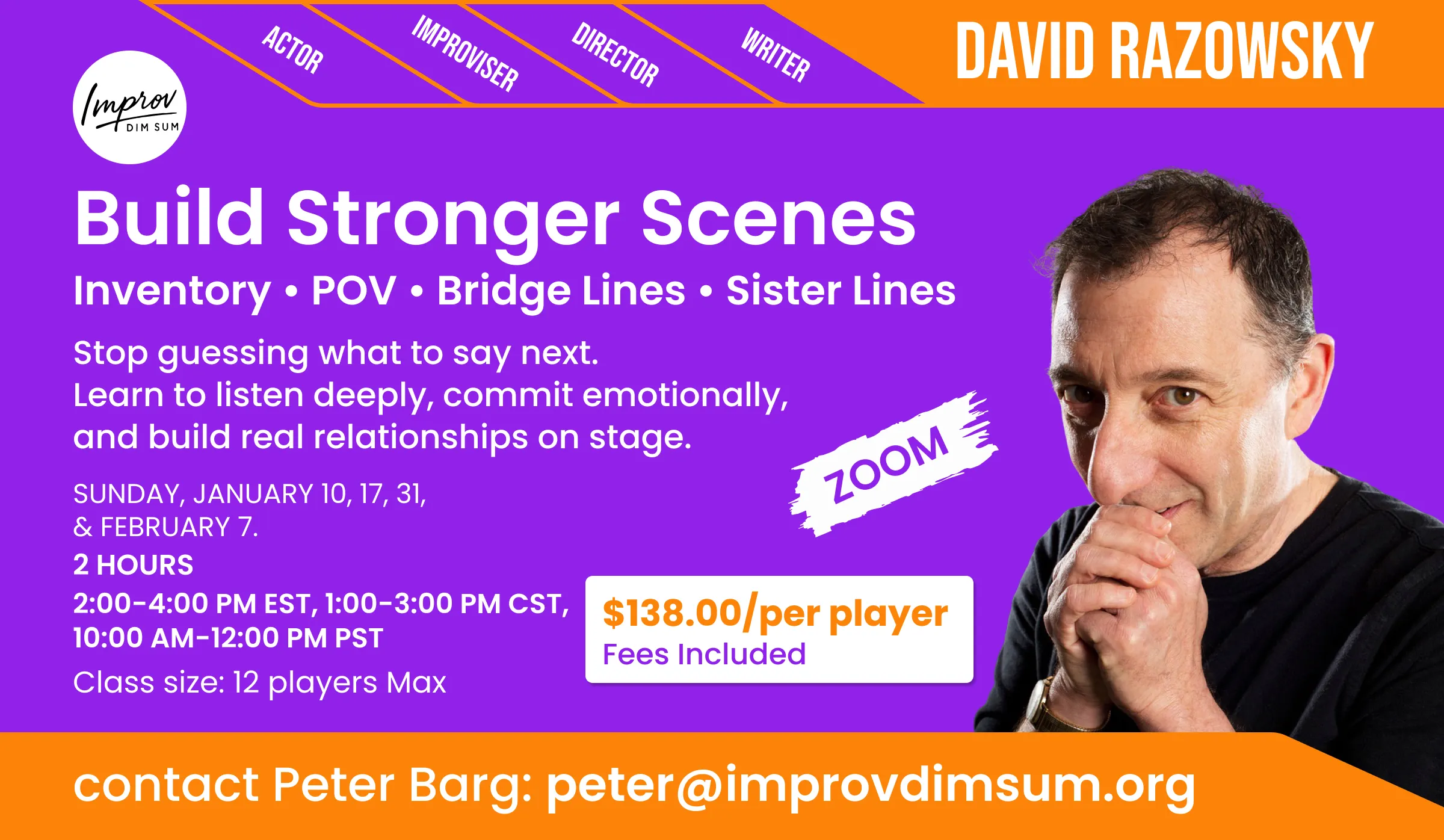
The fundamental approach to a brilliant scene lies entirely in the deep, immediate connection created between two players. While modern improvisation is shaped by an enormous number of historical and artistic influences, this unique 4-week masterclass directly distills, defines, and develops the exact tools you need to foster that connection and organically build a scene from scratch.
By stripping away the pressure to "invent" a plot, you will learn to turn your full attention toward your scene partner, discovering that absolute presence is the ultimate catalyst for compelling theatre.
Workshop Details:
When: Sunday, January 10, 17, 24,31
Time: 2:00-4:00 PM EST, 1:00-3:00 PM CST, 10:00-12 PM PST
Duration: 2 hours
12 Players Max
Cost: $138.00 per participant. All fees included
📅 Curriculum
Taking Inventory — Establishing the Connected Baseline
Before a word is even spoken, the dynamic between two players has already begun. This week focuses on eliminating the pressure to invent an individual premise so you can focus entirely on what exists between you and your partner.
Sister Lines — Textual Anchoring and Shared Space
Discover how language can lock two performers into the exact same physical and emotional reality without relying on forced exposition.
Bridge Lines — Seamless Transitions in Tandem
Learn how two players can shift the direction, tone, or emotional state of a scene together without breaking their connection or jumping tracks.
Point of View — Colliding Perspectives
A scene is never about what happens; it is about how the two players feel about what happens. We wrap up by cementing your character's emotional lens while remaining entirely responsive to your partner.
👤 About the Instructor
David Razowsky is the former Artistic Director of The Second City Los Angeles, host of the podcast A.D.D. Comedy, and author of the best-selling book A Subversive's Guide to Improvisation. A globally recognized master instructor, David has spent decades teaching actors to trade plot-driven anxiety for absolute presence.
During his landmark tenure at The Second City, David wrote, directed, and performed in numerous resident mainstage revues, collaborating with comedic icons including Steve Carell, Stephen Colbert, Amy Sedaris, Chris Farley, Keegan-Michael Key, and Rachel Dratch. Beyond the Second City, he has directed for Amsterdam's Boom Chicago, performed with the Reduced Shakespeare Company at the Kennedy Center, and served as a consultant for DreamWorks.
As a teacher and lecturer, David has served on the adjunct faculty at California State University, taught for Steppenwolf Theatre, and delivered a TEDx Talk in New Zealand. His masterclasses regularly bring him to theaters and festivals across the US, Australia, Europe, and the UK.
💡 Methodology & Philosophy
David’s approach to improvisation strips away rules and mechanics, anchoring performance entirely in mindfulness:
“I have a very simple approach to improvising: Your present awareness is the only thing you need to create compelling, smart, truthful, and surprising scenes... All that matters is now... all you need to bring to my workshop is your present presence." (For more on David’s philosophy, see the full bio on the Second City website)
🥟 About the Host: Improv Dim Sum
Improv Dim Sum curates premium, interactive online workshops, connecting improvisers worldwide with top-tier instructors. Embracing the spirit of "touching the heart," the platform fosters a supportive community designed for connection and creative growth.
